
Start with the light, not the frame shape
Round frames get a lot of attention for style, but the lens tint is what decides how comfortable you are when you step outside. The same round BUG G frame can feel great on a bright court and wrong on a gray morning if the tint is matched to the wrong conditions.
Use this guide to pick a lens tint for bright sun, cloudy days, and running. The goal is not to own every tint; it is to know which one to reach for and why.
Mirrored vs non-mirrored lenses: what changes
Mirror coatings are the most visible difference in lens tint, but they are not the only one. Use this comparison to decide which type fits your typical conditions.
- Mirrored lenses: Mirrored lenses have a reflective coating that reduces the amount of light reaching your eyes. They are a practical choice for bright sun, open fields, courts, and water, where glare is strong and you want less light overall. The trade-off is that a strong mirror can feel too dark in flat, low light.
- Non-mirrored lenses: Non-mirrored lenses rely on the tint itself rather than a reflective coating. They are often a better match for cloudy days, early mornings, and mixed light, where you still want some protection but not a heavy dimming effect. The trade-off is less glare reduction in full sun.
- When to switch: If you squint on bright afternoons but feel like you are looking through a cave on overcast mornings, you are probably using one tint for two different light conditions. Carry the pair that matches the forecast, or keep a lighter non-mirrored pair for gray days.
Picking a lens tint for bright sun
For bright sun, prioritize light reduction and glare control. A mirrored lens is the most direct way to cut the amount of light reaching your eyes, and it is the tint type most often associated with sport and court use.
Look for a mirror finish that is dark enough to take the edge off midday glare without making you feel disconnected from the field. If you play on light-colored courts or near water, glare is stronger, so a mirrored lens earns its place.
Picking a lens tint for cloudy days
Cloudy days still deliver UV and glare, but the light is flatter and less intense. A non-mirrored lens with a lighter tint is usually more comfortable because it does not over-dim the scene.
The mistake to avoid is treating cloudy days as a reason to leave sunglasses at home. A lighter non-mirrored tint keeps you comfortable without the tunnel-vision effect of a heavy mirror. If the forecast is mixed, a non-mirrored lens is the safer default.
A round BUG G frame with a mirrored option
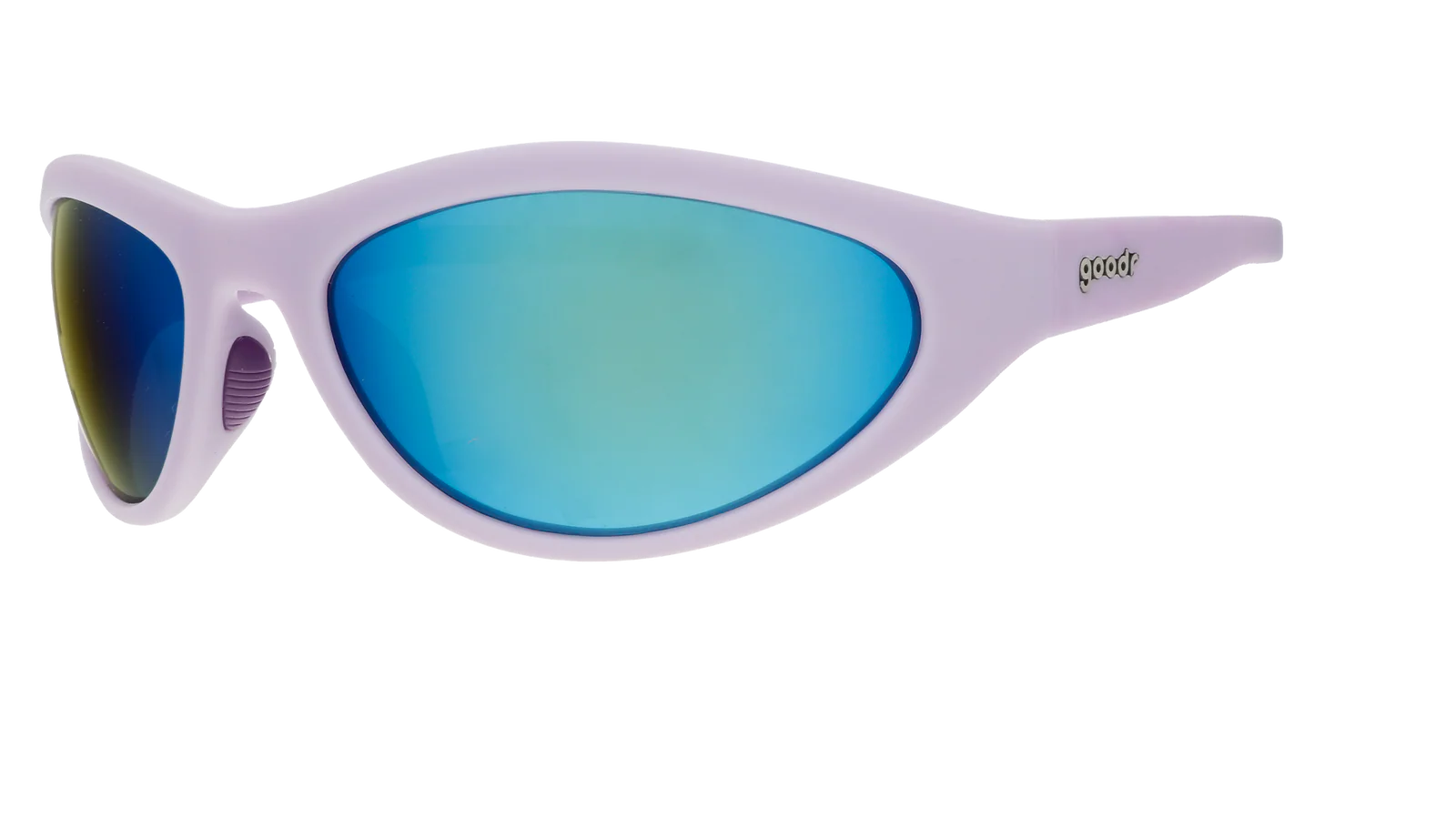
- In My Periwinkle Prime: In My Periwinkle Prime is a round BUG G frame with periwinkle wrap-around shades and teal reflective lenses. The teal reflective lenses make this a mirrored option, which suits bright sun and court or field use where glare is strong.

In My Periwinkle Prime - In My Periwinkle Prime: The catalog states these shades won't slip or bounce while you crush it on the field and on the court. Stability matters when you are choosing a tint for running or court sports, because a frame that moves forces you to adjust it and breaks your focus.
How to choose a tint for running
Running adds motion and sweat to the light question. Use these checkpoints to narrow your choice.
- Check the forecast first: Bright, open courses favor a mirrored lens. Overcast, shaded trails favor a lighter non-mirrored tint. Match the tint to the light you will actually run in, not the light you hope for.
- Prioritize frame stability: A tint is only useful if the frame stays put. Look for a wrap-around fit that won't slip or bounce, like the In My Periwinkle Prime, so you are not pushing your shades back up mid-run.
- Decide on mirror or non-mirror: If you run mostly in full sun, a mirrored lens is the practical pick. If you run at dawn, dusk, or under heavy cloud, a non-mirrored lens keeps the scene readable.
- Keep one pair per condition if you can: Two pairs, one mirrored and one non-mirrored, cover more conditions than one compromise pair. If you only buy one, choose based on the light you encounter most often.
What the supplied information does not confirm
The supplied product record for In My Periwinkle Prime does not include a visible light transmission rating, lens category number, or UV rating. That means you cannot use this record to compare exact light-blocking percentages between tints.
Use the general mirrored vs non-mirrored guidance above and treat the specific lens performance as not confirmed by the supplied information. If you need a precise rating for a specific sport or condition, check the product page or ask the store before buying.
A simple rule to remember
Bright sun and strong glare: reach for a mirrored lens. Cloudy, flat, or mixed light: reach for a lighter non-mirrored lens. Running: pick the tint for the forecast, then make sure the frame won't slip or bounce.
The In My Periwinkle Prime is a clear example of the mirrored side of that rule, with teal reflective lenses and a wrap-around fit built for the field and the court. Pair it with a lighter non-mirrored option for gray days and you cover both ends of the light spectrum.

